

Benzoyl peroxide is usually the stronger first choice for red, inflamed pimples and pustules. Salicylic acid is usually the better match for blackheads, whiteheads and recurring clogged pores, especially in oily, comedone-prone skin. Benzoyl peroxide has stronger guideline support overall, while salicylic acid is a useful over-the-counter option with more limited clinical evidence. Neither one is automatically better for every face.[1]
What this guide covers
Salicylic acid vs benzoyl peroxide: the direct verdict
The internet often presents this as a contest with one winner. Acne does not work that way. A blackhead and a sore pustule are both acne, but they are not the same treatment problem.
| Question | Salicylic acid | Benzoyl peroxide |
|---|---|---|
| Best-supported practical target | Comedonal acne and clogged pores, often in oily skin | Red papules, pustules and mixed inflammatory acne[1] |
| Main action | Helps loosen and shed compacted cells inside oily follicles | Rapidly reduces Cutibacterium acnes through oxidation[6],[13] |
| Evidence strength | Useful, but guideline recommendation is conditional and evidence is limited | Strongly recommended in current acne guidelines[1] |
| Resistance | Not an antibiotic and does not drive antibiotic resistance | No known bacterial resistance, and it helps limit resistance when antibiotics are used[1],[13] |
| Common problem | Stinging, dryness, peeling and over-exfoliation | Dryness, redness, peeling, contact dermatitis and bleached fabrics[9] |
| Conservative starting example | 0.5% to 2% cleanser or a 2% leave-on introduced gradually | 2.5% leave-on or 2.5% to 4% wash introduced gradually[9],[10] |
A person with mostly closed comedones may get more from a well-formulated salicylic acid leave-on than from a harsh 10% benzoyl peroxide wash. A person with frequent pustules may not adequately target the inflammatory component by exfoliating alone. The useful question is not, "Which ingredient is stronger?" It is, "Which part of acne am I trying to treat?"
Start with the bigger picture: Our evidence-based acne treatment guide explains where retinoids, benzoyl peroxide, antibiotics, hormonal treatment and isotretinoin fit across the major acne patterns.
How salicylic acid works
Salicylic acid is a beta hydroxy acid that dissolves in oil. That matters because acne begins inside the pilosebaceous follicle, where sebum and shed cells can collect into a microscopic plug. Salicylic acid helps reduce the cohesion between cells in the outer skin and within the follicle. In practical terms, it makes it easier for compacted material to shed instead of building into blackheads and whiteheads.
It is usually described as keratolytic and comedolytic. Those labels do not mean it "melts sebum" or permanently shrinks pores. It helps clear the material that makes pores look more obvious. It also has some anti-inflammatory activity, but it is not a substitute for a potent anti-inflammatory prescription treatment when acne is deep or severe.
Think prevention and pore traffic. It is most useful when the dominant problem is repeated clogging, rough acne-prone texture, blackheads or small whiteheads. A leave-on provides longer exposure, but direct head-to-head evidence against cleansers is limited. Longer exposure can also increase irritation.
How benzoyl peroxide works
Benzoyl peroxide breaks down in the skin and acts as an oxidizing antimicrobial. Reactive oxygen species oxidize bacterial proteins and reduce Cutibacterium acnes. No bacterial resistance to benzoyl peroxide has been demonstrated. Benzoyl peroxide also has mild keratolytic and anti-inflammatory activity, but its main advantage is antimicrobial action without the resistance problem associated with acne antibiotics.[6],[13]
That is why benzoyl peroxide appears so often in evidence-based acne regimens. It can be used alone, combined with a topical retinoid such as adapalene, or paired with an antibiotic to reduce the chance that resistant bacteria will dominate. It is more than an overnight spot drier. Preventive use across the acne-prone area usually makes more sense than waiting for a pustule to fully form.[1],[9]
Benzoyl peroxide can bleach towels, pillowcases, collars, eyebrows and hair. White bedding and towels are the safest choice. Let leave-on products dry fully before dressing or going to bed.[9]
What the research actually shows
The evidence is not equally deep for the two ingredients. The 2024 American Academy of Dermatology guideline strongly recommends benzoyl peroxide, including its use in combination regimens. Salicylic acid receives a conditional recommendation based on lower-certainty evidence.[1] That does not mean salicylic acid is useless. It means the published clinical trial base is smaller and less consistent.
A classic set of double-blind trials compared 2.5%, 5% and 10% benzoyl peroxide in 153 people with mild to moderately severe acne. In this trial, 2.5% benzoyl peroxide was as effective as 5% and 10% for inflammatory lesions. Burning, redness and peeling were less frequent than with 10%, but similar to 5%.[2] A later randomized trial in 609 participants found both 2.5% and 5% benzoyl peroxide gels effective compared with placebo, with no obvious difference in adverse-event incidence between the two active groups.[3] Higher strength does not reliably produce better acne outcomes, and tolerability depends on both concentration and formulation.
Direct salicylic acid versus benzoyl peroxide trials are limited. One randomized study compared a lipohydroxy acid derivative of salicylic acid with 5% benzoyl peroxide and found improvement with both treatments.[4] A later trial enrolled 150 Caucasian adults at one site and compared 5% benzoyl peroxide with a multi-ingredient La Roche-Posay dermocosmetic containing salicylic acid and other actives. The products performed similarly over eight weeks, and the dermocosmetic was better tolerated.[5] The study was sponsored by L’Oréal, and most authors were L’Oréal employees. It does not prove that every 2% salicylic acid toner is equivalent to benzoyl peroxide.
A Cochrane review concluded that benzoyl peroxide may improve acne more than placebo, but certainty was low for several outcomes and head-to-head evidence remained limited.[6] This is a useful reminder that familiar does not mean perfectly studied. Benzoyl peroxide still has the stronger practical and guideline position, especially for inflammatory acne.
The strongest acne product is the one you can use consistently without turning mild acne into dermatitis.
Stylish & Healthy verdictChoose by breakout type
Mostly blackheads and whiteheads
Start with salicylic acid, especially when the skin is oily and the main issue is recurrent clogging. One conservative example is a 2% leave-on used two or three nights per week, but follow the product label and adjust to tolerance. A cleanser may be easier to tolerate when the barrier is sensitive or when a retinoid is already doing most of the comedone prevention.
Mostly red papules and pustules
Benzoyl peroxide is the more direct match. A 2.5% leave-on or a 2.5% to 4% wash is usually a more tolerable starting point than jumping to 10%. Apply it across the acne-prone zone rather than using a thick blob only on visible spots. Thick application does not make it work faster. It mainly increases dryness.[9]
Mixed acne with clogs and inflamed spots
This is where people often benefit from more than one mechanism. A topical retinoid plus benzoyl peroxide has stronger evidence than building an aggressive routine around several exfoliating acids. Salicylic acid can still be an add-on, but it should earn its place. If the routine already contains adapalene and benzoyl peroxide, adding daily 2% salicylic acid may add irritation, and evidence for additional benefit is limited.
Body acne
Benzoyl peroxide washes are usually practical for the chest, back and shoulders. The area is large, and a wash can cover it quickly. Let the cleanser sit only as directed on the label, rinse thoroughly, and use white towels. Salicylic acid body washes can help rough clogged follicles, while inflamed truncal acne often benefits from benzoyl peroxide. Widespread, painful or scarring truncal acne may need prescription treatment.
Very sensitive, dry or barrier-damaged skin
Do not assume salicylic acid is automatically gentle because it appears in cosmetic toners. Both ingredients can cause irritant dermatitis. A short-contact wash, lower frequency, bland moisturizer and one new active at a time are safer. When even moisturizer burns, pause the acne active and read our guide to telling skin barrier damage from acne.
Deep nodules, cysts or scarring acne
Neither over-the-counter ingredient is enough as a complete plan. Painful nodules and new scars are reasons to seek professional treatment early.[10] Delaying effective care while rotating cleansers can allow permanent scarring. Benzoyl peroxide may still be part of the regimen, but it should not be the entire strategy.
Which strength should you use?
Salicylic acid: 0.5% to 2%
For acne, US over-the-counter salicylic acid products range from 0.5% to 2%.[9] Concentration is only part of the formula. A 2% cleanser and a 2% leave-on differ in vehicle, pH, contact time and use, but those differences do not prove that every leave-on will outperform every cleanser. Start with the least intense format that matches the problem. When a 2% leave-on works at a lower frequency, there is no prize for forcing daily use.
Benzoyl peroxide: 2.5%, 4%, 5% or 10%
US over-the-counter benzoyl peroxide products range from 2.5% to 10%.[9] For facial leave-on treatment, 2.5% is a strong starting point because it performed similarly to 5% and 10% for inflammatory lesions in a classic trial.[2] Four percent is common in washes. A 5% product may be tried when a lower strength is tolerated but insufficient, following the label or clinician advice. Ten percent is a maximum-strength option, but superiority over lower strengths for body acne is not established.
Use schedule note: These are conservative examples, not prescriptions. Follow the product label and clinician instructions, and reduce frequency if irritation develops.
| Format | Conservative example | Possible next step |
|---|---|---|
| 2% salicylic acid leave-on | Two to three nights per week | Increase only if there is no persistent sting, redness or peeling |
| Salicylic acid cleanser | Once daily or several times per week | Twice daily is rarely necessary when another active is used |
| 2.5% benzoyl peroxide leave-on | Thin layer every other morning or night | Increase frequency before increasing strength |
| 2.5% to 4% BPO wash | Short contact once daily or every other day | Adjust contact time only within label directions and if tolerated; do not assume 10% is better |
| 10% BPO wash | Maximum-strength truncal option when the label allows | Consider only when lower strengths were tolerated and insufficient |
Can you use salicylic acid and benzoyl peroxide together?
Yes, but there is no requirement to layer them in the same routine. The combination targets different parts of acne, which can be useful. The problem is tolerability. Burning, tightness and shiny irritated skin can make the entire routine fail.
- Start one active first. Wait until tolerability is clear before adding another product. One to two weeks is a practical example, not a universal rule.
- Add the second at a different time. For example, use a salicylic acid cleanser in the morning and a benzoyl peroxide treatment at night.
- Do not increase both at once. Change one variable, then watch the skin.
- Moisturize before the skin feels dry. A simple fragrance-free moisturizer is part of acne treatment, not an optional rescue.
- Stop escalating when the skin becomes persistently sore. More peeling is not proof of more acne clearance.
Adapalene and benzoyl peroxide are commonly combined and are available together in prescription products. Traditional tretinoin can be oxidized by benzoyl peroxide in some formulations, while stabilized formulations may differ. Follow the instructions for the exact product or separate application times when directed. Adding salicylic acid on top of a retinoid and benzoyl peroxide should be conservative.
Benzoyl peroxide and benzene: what changed?
In March 2025, the US Food and Drug Administration reported testing 95 benzoyl peroxide acne products for possible benzene contamination. More than 90% had undetectable or extremely low benzene levels, while a small number led to limited voluntary recalls.[7] The FDA described the cancer risk from the recalled products as very low, even with long-term daily use.[8]
This does not mean storage is irrelevant. Benzoyl peroxide can degrade under heat. Follow the label, keep it at room temperature or cooler, replace it every 10 to 12 weeks, and discard it after exposure above 78°F or 25.6°C, according to current AAD guidance.[12] Do not leave it in a hot car or direct sun. It also does not mean every benzoyl peroxide product is unsafe. The FDA's retail-level testing did not support that conclusion.
The six products we would actually consider
We did not select products by popularity alone. Each formula was judged on active strength, whether the format makes sense, irritation risk, supportive ingredients, value and how likely a normal person is to use it correctly. These are editorial ratings, not results from head-to-head clinical trials. A score above 4 means strong within this review. A 5 would require very few meaningful trade-offs.
Affiliate disclosure: This article contains affiliate links. If you buy through them, Stylish & Healthy may earn a commission at no extra cost to you. Affiliate relationships do not affect product selection, editorial ratings or scientific conclusions.
Our salicylic acid product picks
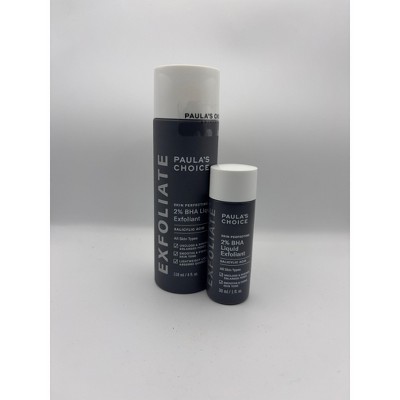
Paula's Choice Skin Perfecting 2% BHA Liquid Exfoliant
In our editorial scoring, this is the preferred all-round salicylic acid leave-on in the group. The formula is short and fragrance-free. It uses solvents as the vehicle for a 2% leave-on acid, but that does not prove superior delivery against every competitor. Green tea has a plausible soothing and antioxidant role, though its clinical contribution in this finished formula is not established. The liquid may feel slick or tacky to some users, and daily use can be too irritating for some skin.
- Full 2% leave-on strength
- No fragrance or drying alcohol
- Short formula with no unnecessary active overload
- More useful for widespread clogs than occasional spot use
- Expensive for a simple formula
- Finish can feel slick or tacky
- Can still cause burning or peeling if used too often
- Not automatically suitable for rosacea or a damaged barrier
Full INCI list, checked August 2, 2026
Water (Aqua), Methylpropanediol, Butylene Glycol, Salicylic Acid, Polysorbate 20, Camellia Oleifera Leaf Extract, Sodium Hydroxide, Tetrasodium EDTA. Formula order checked against the linked regional page on August 2, 2026.
Strict verdict: The score reflects the active strength, delivery format, irritation risk, formula support, value and how easy it is to use correctly. It is not a score for the brand.

The Ordinary Salicylic Acid 2% Solution, US OTC version
The Ordinary gives you the same labeled salicylic acid strength in a cheaper, smaller bottle. The formula uses saccharide isomerate for hydration and a simple gel structure. Its published pH range of 3.20 to 4.00 is appropriate for an acid treatment. It is not padded with soothing extracts, ceramides or lipids, so the rest of the routine has to carry the barrier-support work. That is not a defect, but it makes careless daily use easier to regret.
- Very good price per trial bottle
- Appropriate 2% strength and acidic pH range
- Fragrance-free
- Simple formula that layers more cleanly than many oily-feeling BHA liquids
- Less buffered by soothing or barrier-support ingredients
- Small bottle
- Can pill if layered too heavily
- Using it with several other acids is a fast route to irritation
Full INCI list, checked August 2, 2026
Active ingredient: Salicylic Acid 2%. Inactive ingredients from the US Drug Facts panel: Cocamidopropyl Dimethylamine, Chlorphenesin, Citric Acid, Hydroxyethylcellulose, Phenoxyethanol, Polysorbate 20, Saccharide Isomerate, Sodium Citrate, Sodium Hydroxide, Water. Checked August 2, 2026; the brand notes that formulas can vary by time and region.
Strict verdict: The score reflects the active strength, delivery format, irritation risk, formula support, value and how easy it is to use correctly. It is not a score for the brand.

CeraVe Acne Control Cleanser
This is a sensible cleanser when a leave-on 2% acid feels like too much. It combines salicylic acid with glycerin, niacinamide, ceramides and cholesterol, but those support ingredients do not cancel out the fact that it is a foaming, oil-absorbing cleanser. Hectorite clay may help with shine, while the rinse-off format reduces exposure time. Shorter contact may limit exposure, but direct head-to-head efficacy evidence against leave-on products is limited. It is useful, not magical.
- Full 2% acne active in a rinse-off format
- No added fragrance
- Contains glycerin, niacinamide, ceramides and cholesterol
- Practical for oily skin and larger acne-prone areas
- Shorter contact may limit exposure, but direct comparative evidence is limited
- Clay plus surfactants can feel tight on dry skin
- Long ingredient list is not proof of stronger acne control
- Twice-daily use may be excessive when another active is already in the routine
Full INCI list, checked August 2, 2026
Active: Salicylic Acid 2%. Inactive: Water, Sodium Lauroyl Sarcosinate, Cocamidopropyl Hydroxysultaine, Glycerin, Niacinamide, Gluconolactone, Sodium Methyl Cocoyl Taurate, PEG-150 Pentaerythrityl Tetrastearate, Ceramide NP, Ceramide AP, Ceramide EOP, Carbomer, Calcium Gluconate, Triethyl Citrate, Sodium Benzoate, Sodium Hydroxide, Sodium Lauroyl Lactylate, Cholesterol, Tetrasodium EDTA, Caprylyl Glycol, Hydrolyzed Hyaluronic Acid, Trisodium Ethylenediamine Disuccinate, Xanthan Gum, Hectorite, Phytosphingosine, Benzoic Acid.
Strict verdict: The score reflects the active strength, delivery format, irritation risk, formula support, value and how easy it is to use correctly. It is not a score for the brand.
Our benzoyl peroxide product picks

CeraVe Acne Foaming Cream Cleanser
Four percent is a practical editorial choice for a rinse-off benzoyl peroxide cleanser. The formula includes glycerin, niacinamide, hyaluronic acid, ceramides and cholesterol. Despite those supportive ingredients, the finished cleanser may still feel drying or sting some users. It should not be treated as equivalent to a non-medicated gentle cleanser.
- Useful 4% strength in a short-contact format
- Includes glycerin, niacinamide, hyaluronic acid, ceramides and cholesterol
- Fragrance-free
- Practical face and limited body option for inflamed acne
- May still feel drying or sting some users
- Can bleach towels and clothing
- May be too drying for eczema-prone or very dry skin
- The extra glycolic acid is not necessary for everyone
Full INCI list, checked August 2, 2026
Active: Benzoyl Peroxide 4%. Inactive: Water, Glycerin, Propylene Glycol, Cocamidopropyl Hydroxysultaine, Sodium C14-16 Olefin Sulfonate, Xanthan Gum, Potassium Hydroxide, Ceramide NP, Ceramide AP, Ceramide EOP, Carbomer, Niacinamide, Glycolic Acid, Sodium Chloride, Sodium Citrate, Sodium Hyaluronate, Sodium Lauroyl Lactylate, Sodium Hydroxide, Cholesterol, Phenoxyethanol, Propanediol, Citric Acid, Tetrasodium EDTA, Diethylhexyl Sodium Sulfosuccinate, Phytosphingosine, Ethylhexylglycerin, Benzoic Acid.
Strict verdict: The score reflects the active strength, delivery format, irritation risk, formula support, value and how easy it is to use correctly. It is not a score for the brand.
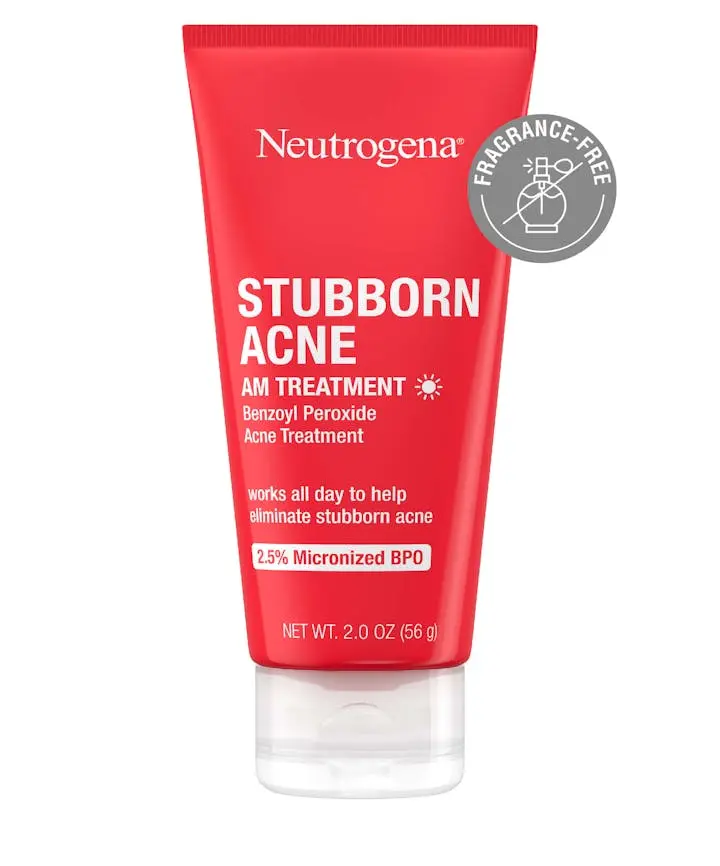
Neutrogena Stubborn Acne AM Treatment
The concentration is the main reason this product scores well. Research does not support the assumption that 10% is automatically more effective than 2.5% for facial inflammatory acne. The current label lists a short, fragrance-free base. Laureth-4 and the finished leave-on format may still bother very reactive or barrier-damaged skin. Longer exposure can increase irritation and bleaching risk, although tolerability depends on the complete formula and use.
- 2.5% is a rational starting strength
- The current label identifies the benzoyl peroxide as micronized
- Fragrance-free and relatively short formula
- Suitable for thin application across acne-prone zones when directed
- Leave-on format can be drying
- May still sting compromised skin
- Will bleach dyed fabrics and may lighten hair
- Needs careful storage away from excessive heat
Full INCI list, checked August 2, 2026
Active: Benzoyl Peroxide 2.5%. Inactive: Water, Carbomer Homopolymer Type B, Ethylhexylglycerin, Sodium Hydroxide, Chlorphenesin, Disodium EDTA, Laureth-4, Hydroxypropyl Methylcellulose. Current DailyMed label checked August 2, 2026.
Strict verdict: The score reflects the active strength, delivery format, irritation risk, formula support, value and how easy it is to use correctly. It is not a score for the brand.
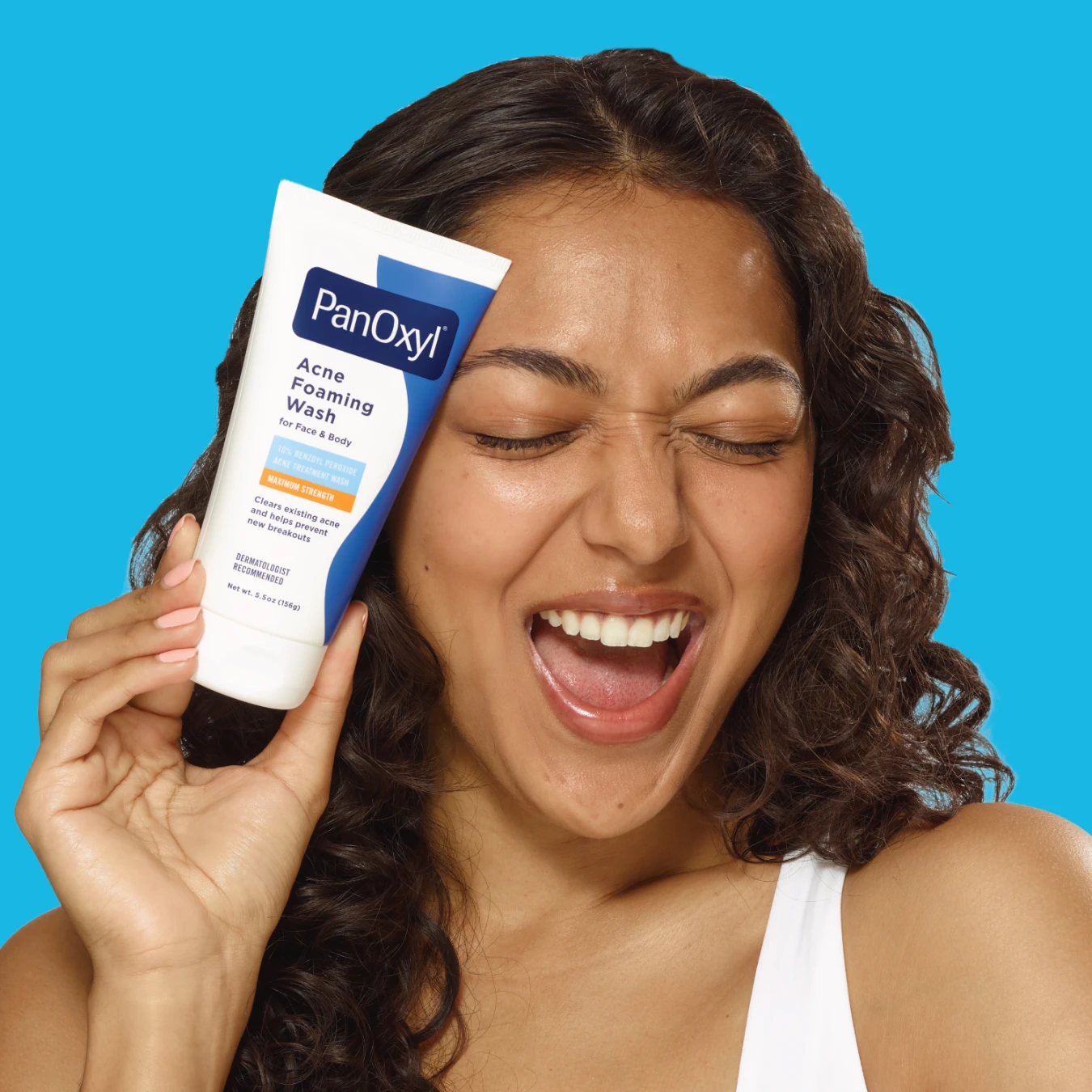
PanOxyl Acne Foaming Wash 10%
This is not our default recommendation for a beginner's face. Ten percent benzoyl peroxide brings more irritation risk without clear proof that it will outperform a lower strength for ordinary facial acne. It is a maximum-strength wash that some people use on the trunk, but lower strengths may work and be better tolerated. Follow the exact label contact time. The formula includes glycerin and dimethicone, but a 10% medicated wash can still be harsh.
- Maximum OTC benzoyl peroxide strength
- Large wash format can suit larger body areas
- Rinse-off format limits contact compared with a leave-on 10% gel
- No added fragrance in the listed formula
- Too aggressive for many faces
- Higher concentration is not automatically more effective
- Can cause marked dryness, redness and peeling
- Still bleaches towels, clothes and bedding
Full INCI list, checked August 2, 2026
Active: Benzoyl Peroxide 10%. Inactive: Carbomer Homopolymer Type C, Carbomer Interpolymer Type A, Decyl Glucoside, Dimethicone, Dioctyl Sodium Sulfosuccinate, Glycerin, Palmitic Acid, Polyacrylate Crosspolymer-6, Polyoxyl 40 Stearate, Propanediol, Purified Water, Silica, Sodium Chloride, Sodium Citrate, Sodium Hydroxide, Sodium Laurylglucosides Hydroxypropylsulfonate, Sorbitan Stearate, Stearic Acid, T-Butyl Alcohol, Xanthan Gum.
Strict verdict: The score reflects the active strength, delivery format, irritation risk, formula support, value and how easy it is to use correctly. It is not a score for the brand.
The full ingredient lists above were checked on August 2, 2026 against the linked US or regional official pages and the current DailyMed label for Neutrogena. Always compare them with the box or bottle you are buying. Formulas and regional versions can change.
Our editorial picks by use case
| Use case | Editorial pick | Editorial rationale |
|---|---|---|
| Preferred 2% salicylic acid leave-on in this review | Paula's Choice 2% BHA Liquid | Focused 2% leave-on formula with no fragrance and relatively few ingredients |
| Budget salicylic acid pick | The Ordinary Salicylic Acid 2% Solution, US OTC version | Correct strength, published pH range and a low price at the audit date |
| Salicylic acid cleanser pick | CeraVe Acne Control Cleanser | Useful for oily skin when a leave-on acid is too much |
| Benzoyl peroxide wash pick | CeraVe 4% Acne Foaming Cream Cleanser | Practical strength with several supportive ingredients, though it can still irritate |
| Benzoyl peroxide leave-on pick | Neutrogena 2.5% AM Treatment | Evidence-aligned starting concentration without defaulting to maximum strength |
| Maximum-strength truncal wash pick | PanOxyl 10% | A high-strength option for the chest and back when tolerated; lower strengths may work |
Simple routines that make sense
Routine for blackheads and oily clogged skin
- Morning: gentle cleanser, light moisturizer, broad-spectrum sunscreen.
- Evening: gentle cleanser, 2% salicylic acid leave-on two or three nights per week, moisturizer.
- Do not add: scrub, acid pads and an exfoliating mask on the same nights.
Routine for red inflamed pimples
- Morning: 2.5% to 4% benzoyl peroxide wash or a thin layer of 2.5% leave-on, moisturizer, sunscreen.
- Evening: gentle cleanser, moisturizer. A retinoid may be added gradually when appropriate.
- Protect fabrics: use white towels and wash hands after application.
Routine for mixed acne
- Morning: benzoyl peroxide wash, moisturizer, sunscreen.
- Evening: gentle cleanser, retinoid if suitable, moisturizer.
- Optional: salicylic acid once or twice weekly only if clogged pores remain and the skin is fully comfortable.
Routine for body acne
- Use a benzoyl peroxide wash on affected skin in the shower.
- Leave it on for the label-directed contact time, then rinse thoroughly.
- Use white towels and breathable clothing.
- Seek care when body acne is painful, widespread or scarring.
Related reading: Learn why acne can return in the same spot, how to fade post-acne dark spots without damaging your barrier, and how to recognize when active acne is becoming a scarring problem.
Common mistakes that make both ingredients look ineffective
Treating only visible spots
Preventive acne actives usually work better across the whole acne-prone area in a thin layer.[9]
Changing products every week
Allow at least 6 to 8 weeks before judging early improvement. Complete clearing can take 3 to 4 months, unless irritation or worsening requires an earlier change.[10]
Using the strongest percentage first
Ten percent benzoyl peroxide can create more irritation without giving better facial results than 2.5%.
Confusing irritation with purging
Do not dismiss burning, diffuse redness, cracking or persistent tenderness as purging. Treat them as irritation and reduce or stop the suspected irritant.
Skipping moisturizer
A damaged barrier lowers adherence and can make every active sting. Moisturizer helps you stay consistent.
Ignoring acne severity
Deep nodules, scars and major distress deserve medical care, not a longer cleanser experiment.
Frequently asked questions
Is salicylic acid or benzoyl peroxide better for blackheads?
Salicylic acid is usually the more logical choice for blackheads and whiteheads because it exfoliates inside oily follicles and helps reduce the material that forms comedones. Benzoyl peroxide can help mixed acne, but its main advantage is controlling inflamed lesions.[1]
Which is better for red, inflamed pimples?
Benzoyl peroxide usually has the stronger case for red papules and pustules because it reduces Cutibacterium acnes and is strongly recommended in acne guidelines. In a classic trial, 2.5% benzoyl peroxide was as effective as 5% and 10% for inflammatory lesions. Burning, redness and peeling were less frequent than with 10%, but similar to 5%.[1],[2]
Can salicylic acid and benzoyl peroxide be used together?
Yes, but using both at once is not automatically better. A cautious routine may use one in the morning and the other at night, or alternate days. Start one product first, add the second only after the skin is stable, and reduce frequency if burning, persistent redness or peeling develops.
Is 10% benzoyl peroxide better than 2.5%?
Not necessarily. In a classic trial, 2.5% benzoyl peroxide was as effective as 5% and 10% for inflammatory lesions. Burning, redness and peeling were less frequent than with 10%, but similar to 5%. A 10% wash may be an option for truncal acne when tolerated, but lower strengths may work.[2]
How long do these acne treatments take to work?
Allow at least 6 to 8 weeks before judging early improvement. Complete clearing can take 3 to 4 months. Deep painful acne, scarring acne or acne that is clearly worsening should be assessed sooner.[10]
Can sensitive skin use either ingredient?
Sensitive skin may tolerate a short-contact cleanser or a low-strength leave-on used only a few times per week. Salicylic acid is not automatically gentle, and benzoyl peroxide is not automatically too harsh. Vehicle, concentration, frequency and the rest of the routine matter.
Does benzoyl peroxide cause antibiotic resistance?
No bacterial resistance to benzoyl peroxide has been demonstrated. It is commonly paired with topical or oral antibiotics because this helps reduce selection of antibiotic-resistant acne bacteria.[1],[13]
What should I use during pregnancy?
The American Academy of Dermatology says limited benzoyl peroxide and limited-time salicylic acid use are generally considered acceptable during pregnancy, but discuss use with an obstetric clinician or dermatologist.[11]
Final verdict
Choose salicylic acid when clogged pores are the main problem. Choose benzoyl peroxide when inflamed acne is the main problem. When both are present, do not automatically layer both at maximum frequency. A retinoid and benzoyl peroxide often form the stronger evidence-based foundation, with salicylic acid added only when it solves a remaining problem.
For most faces, 2.5% benzoyl peroxide is a more evidence-aligned starting point than 10%. A 2% salicylic acid leave-on may be used less frequently if daily use irritates the skin.[2]
The honest answer is not that one ingredient wins. The right mechanism, strength and format win.
Research references
- Reynolds RV, Yeung H, Cheng CE, Cook-Bolden F, Desai SR, Druby KM, Freeman EE, Keri JE, Stein Gold LF, Tan JKL, Tollefson MM, Weiss JS, Wu PA, Zaenglein AL, Han JM, Barbieri JS. Guidelines of care for the management of acne vulgaris. Journal of the American Academy of Dermatology. 2024;90(5):1006.e1-1006.e30. doi:10.1016/j.jaad.2023.12.017. PMID: 38300170. PubMed.
- Mills OH Jr, Kligman AM, Pochi P, Comite H. Comparing 2.5%, 5%, and 10% benzoyl peroxide on inflammatory acne vulgaris. International Journal of Dermatology. 1986;25(10):664-667. doi:10.1111/j.1365-4362.1986.tb04534.x. PMID: 2948929. PubMed.
- Kawashima M, Sato S, Furukawa F, Matsunaga K, Akamatsu H, Igarashi A, Tsunemi Y, Hayashi N, Yamamoto Y, Nagare T, Katsuramaki T. Twelve-week, multicenter, placebo-controlled, randomized, double-blind, parallel-group, comparative phase II/III study of benzoyl peroxide gel in patients with acne vulgaris: A secondary publication. The Journal of Dermatology. 2017;44(7):774-782. doi:10.1111/1346-8138.13798. PMID: 28295516. PubMed.
- Bissonnette R, Bolduc C, Seité S, Nigen S, Provost N, Maari C, Rougier A. Randomized study comparing the efficacy and tolerance of a lipophillic hydroxy acid derivative of salicylic acid and 5% benzoyl peroxide in the treatment of facial acne vulgaris. Journal of Cosmetic Dermatology. 2009;8(1):19-23. doi:10.1111/j.1473-2165.2009.00418.x. PMID: 19250161. PubMed.
- Dal Belo SE, Kanoun-Copy L, Lambert C, Cornillon C, Muller B, Jouni H, Moreau M, Palamarchuk I, Kerob D, Aguilar L. Efficacy of a multitargeted, salicylic acid-based dermocosmetic cream compared to benzoyl peroxide 5% in Acne vulgaris: Results from a randomized study. Journal of Cosmetic Dermatology. 2024;23(3):891-897. doi:10.1111/jocd.16052. PMID: 37941097. One-site study sponsored by L’Oréal Group; most authors were L’Oréal employees. PubMed.
- Yang Z, Zhang Y, Lazic Mosler E, Hu J, Li H, Zhang Y, Liu J, Zhang Q. Topical benzoyl peroxide for acne. Cochrane Database of Systematic Reviews. 2020;2020(3):CD011154. doi:10.1002/14651858.CD011154.pub2. PMID: 32175593. PubMed.
- US Food and Drug Administration. Limited number of voluntary recalls initiated after FDA testing of acne products for benzene; findings show a small number of products with elevated levels of benzene contamination. March 11, 2025. Accessed August 2, 2026. FDA.
- US Food and Drug Administration. Frequently Asked Questions on Benzene Contamination in Drugs. Accessed August 2, 2026. FDA.
- US Food and Drug Administration. OTC Monograph M006: Topical Acne Drug Products for Over-the-Counter Human Use. November 23, 2021. Accessed August 2, 2026. FDA monograph.
- American Academy of Dermatology. Acne: Diagnosis and treatment. Accessed August 2, 2026. AAD.
- American Academy of Dermatology. Is any acne treatment safe to use during pregnancy? Accessed August 2, 2026. AAD.
- American Academy of Dermatology. American Academy of Dermatology issues statement on benzoyl peroxide in OTC personal care products. Accessed August 2, 2026. AAD.
- Sagransky M, Yentzer BA, Feldman SR. Benzoyl peroxide: a review of its current use in the treatment of acne vulgaris. Expert Opinion on Pharmacotherapy. 2009;10(15):2555-2562. doi:10.1517/14656560903277228. PMID: 19761357. PubMed.
Product formula sources
- Paula's Choice Skin Perfecting 2% BHA Liquid Exfoliant (formula checked August 2, 2026).
- The Ordinary Salicylic Acid 2% Solution, US OTC Drug Facts (formula checked August 2, 2026).
- CeraVe Acne Control Cleanser (formula checked August 2, 2026).
- CeraVe Acne Foaming Cream Cleanser (formula checked August 2, 2026).
- Neutrogena Stubborn Acne AM Treatment, current DailyMed label (formula checked August 2, 2026).
- PanOxyl Acne Foaming Wash 10% (formula checked August 2, 2026).
Medical disclaimer: This article is for education and cannot diagnose or treat a medical condition. Stop use. Seek urgent medical care for breathing difficulty, facial or throat swelling, widespread hives or severe blistering. See a dermatologist for painful nodules, scarring, widespread acne, major emotional distress, pregnancy-related treatment decisions or acne that is not improving with consistent correct use.
Clear skin needs a plan, not punishment.
Filip, Stylish & Healthy